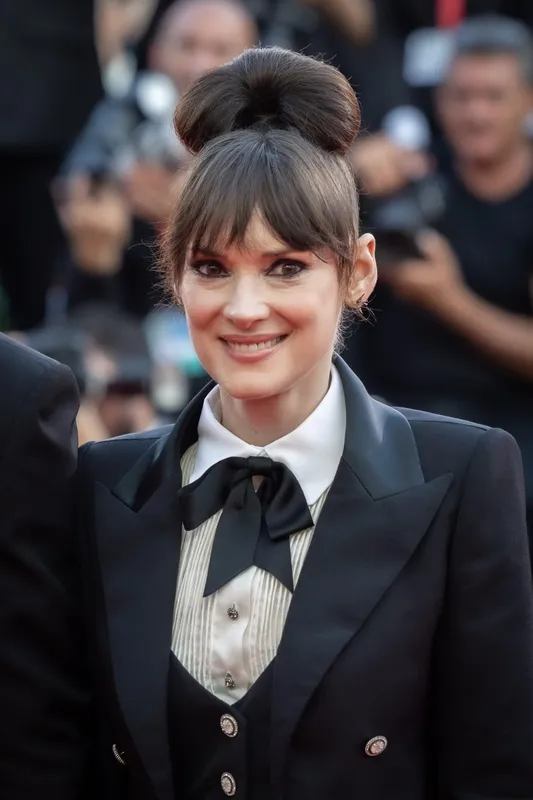
Winona Ryder
American actress
Winona Ryder is an American actress whose career has spanned the transition from celebrated teen star of the late 1980s to respected veteran of film and prestige television. With a delicate, expressive screen presence and a knack for playing intelligent, restless outsiders, she became one of the defining performers of her generation.
Early Life and Breakthrough
Born Winona Laura Horowitz in Winona, Minnesota, she grew up in a creative, intellectually curious household and spent part of her childhood on a Northern California commune. She adopted the stage name Ryder early on and made her film debut in "Lucas" (1986) while still a teenager. Recognition arrived quickly with Tim Burton's "Beetlejuice" (1988), in which she played the morbidly stylish Lydia Deetz, and the dark high-school satire "Heathers" (1989), which became a cult classic. These roles established her as a thoughtful, slightly gothic counterpoint to the conventional ingenue.
The early 1990s cemented her stardom. She reunited with Burton for "Edward Scissorhands" (1990), appeared in Francis Ford Coppola's "Bram Stoker's Dracula" (1992), and earned acclaim in "Mermaids." Her performance in Martin Scorsese's "The Age of Innocence" (1993) brought her first Academy Award nomination, and the following year she received a second nomination for the title role in "Little Women" (1994), playing Jo March with warmth and spirited independence.
Range and Recognition
Ryder continued to seek out varied material throughout the decade. She starred in "Reality Bites" (1994), a touchstone film for Generation X, and took on the role of a young psychiatric patient in "Girl, Interrupted" (1999), a project she helped shepherd to the screen as a producer. The film won a Supporting Actress Oscar for co-star Angelina Jolie and underlined Ryder's willingness to share the spotlight in service of a story she believed in. Across these years she demonstrated a rare combination of commercial appeal and an instinct for emotionally complex, literary-minded projects.
The early 2000s brought professional and personal difficulties, including a widely publicized legal episode that led to a period away from leading roles. Rather than disappearing, she gradually rebuilt her career through carefully chosen supporting parts, appearing in films such as "A Scanner Darkly," "Star Trek" (2009), and Darren Aronofsky's "Black Swan" (2010). These appearances showcased a more mature performer comfortable in character-driven ensembles.
Resurgence and Legacy
Ryder's most prominent late-career role came with the Netflix series "Stranger Things," beginning in 2016, in which she plays Joyce Byers, a determined mother searching for her missing son. The show's enormous global popularity introduced her to a new generation of viewers and reaffirmed her ability to anchor a sprawling ensemble with raw, anxious intensity. She has also continued to work in independent film and limited series, including the drama "The Plot Against America."
Throughout her career, Ryder has been admired for her selectivity and her connection to filmmakers who prize atmosphere and character over spectacle. Closely associated with the alternative sensibility of the late 1980s and 1990s, she remains a cultural touchstone, an actress who helped redefine what a young leading woman could be in Hollywood and who has gracefully sustained relevance across multiple eras of entertainment.
Videos
FAQ
Winona Ryder — Frequently asked questions
How old is Winona Ryder?+
Winona Ryder was born on October 29, 1971, which makes 54 years old.
Where is Winona Ryder from?+
Winona Ryder is from United States.
What is Winona Ryder known for?+
Winona Ryder is best known as Actor, Musician, Character actor. Notable work includes Beetlejuice, Edward Scissorhands, The Age of Innocence, Girl Interrupted, Stranger Things.
How tall is Winona Ryder?+
Winona Ryder is 0.02 m (2 cm) tall.
Is Winona Ryder on social media?+
Yes — Winona Ryder is on Facebook. You can find the official links on this page.