Xi Jinping Invokes 'Thucydides Trap' at White House Summit With Trump

The Chinese president laid out conditions for avoiding military conflict with the US, calling for sustained dialogue, military communication, and student exchanges.
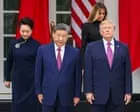
Chinese President Xi Jinping used a White House summit with Donald Trump to present a framework he argued could prevent the world's two largest powers from sliding toward military confrontation, invoking an ancient concept that has become a touchstone in modern geopolitical analysis. Xi's proposals arrived at a moment of sharpening competition between Washington and Beijing over artificial intelligence, trade, and the status of Taiwan, according to The Guardian World.
Xi's Framework for Avoiding Conflict
Addressing Trump at the opening of their bilateral meeting, Xi called on both nations to avoid the "Thucydides trap" — a term drawn from ancient Greek history that describes the dangerous dynamic that can emerge when a rising power threatens to displace an established one. Xi argued that cooperation, rather than confrontation, remained the only path that would benefit both sides.
"China and the United States, as two major countries, stand to gain from cooperation and will both lose in confrontation," Xi said, urging both militaries to maintain regular dialogue and strengthen mechanisms for crisis management and prevention. He also proposed a people-to-people initiative: an invitation for 100,000 young Americans to visit China on student exchange programs.
Xi had previously raised the Thucydides trap framing during a meeting with Trump in Beijing in May, pressing the American president directly on how he intended to prevent such an outcome. The repeated invocation signals that Beijing views the concept as a serious organizing principle for the relationship, not rhetorical decoration.
Trump's Reception and Unusual Diplomatic Gesture
The summit opened with a display of personal warmth that stood out against the broader backdrop of bilateral friction. In a notably rare diplomatic gesture, Trump traveled to Andrews Air Force Base the evening before to meet Xi and his wife, Peng Liyuan, on the tarmac — a break from standard protocol detailed further in coverage of Trump's arrival greeting for the Chinese delegation.
At the formal White House welcome ceremony, Trump noted that Xi was the first Chinese leader to make a second state visit to the United States, with the previous trip having taken place in 2015 under President Barack Obama. Trump credited the two leaders with building "a truly great friendship" and said their teams had been working toward a more balanced trading relationship, including improved market access for American agricultural producers.
State Dinner Brings Tech Industry Giants to the Table
Later Thursday, Trump hosted Xi at a state dinner that drew some of the most prominent figures in American technology and business. Nvidia CEO Jensen Huang, Meta CEO Mark Zuckerberg, Apple chair Tim Cook, Elon Musk of SpaceX and Tesla, and OpenAI CEO Sam Altman were among those in attendance. The guest list underscored how deeply intertwined the AI rivalry has become with the broader diplomatic relationship — the same industry leaders whose companies operate under strict US export controls designed to limit China's access to advanced semiconductors and chip-making equipment were seated at the table with the Chinese president. Details on the evening's attendees and one notable media exclusion are covered in reporting on CNN's barring from the Xi state dinner.
Xi told the dinner that talks with Trump during the visit had produced "common understanding on many issues" and called on both nations to act as "responsible major countries."
Skepticism Persists Despite Cordial Tone
Despite the carefully managed atmosphere of goodwill, analysts have expressed measured skepticism about whether the summit will yield durable agreements. The trade truce that Trump and Xi reached in South Korea last year — designed to keep tariffs from escalating further — had been set to expire in November but was extended through February, US Treasury Secretary Scott Bessent confirmed. The extension buys time but does not resolve the underlying structural tensions that have defined the relationship for years.
Xi's engagement with Trump fits a broader pattern of Chinese diplomatic outreach. The Chinese president has also worked to consolidate relationships across multiple regions, including hosting Cambodian leader Hun Sen to strengthen ties in Southeast Asia. Whether the language of partnership expressed at the White House translates into measurable policy shifts on AI exports, tariffs, or Taiwan remains an open question that analysts say will define the relationship in the months ahead.
 ProfileXi JinpingGeneral Secretary of the Communist Party of China
Related
California Senate Passes Post-Production Tax Bill; Newsom Must Act
SB 2319 cleared the California State Senate 33-5, creating a dedicated post-production tax incentive as the L.A. film industry continues to shrink.

Netanyahu Condemns West Bank Attack on NBC News Team as Settler Violence Escalates
Masked settlers assaulted an NBC News crew and a Palestinian woman in Jalud, injuring four journalists and drawing condemnation from Israel's prime minister.
Park Service Backs Trump Arch Despite Threat to DC Landmark Sightlines
A federal report endorses the proposed 250-foot gilded arch while acknowledging it will disrupt the visual integrity of dozens of historic Washington sites.