Terry Matalas on VisionQuest's Finale and His Tribute to Patrick Stewart

The showrunner opens up about the supersized VisionQuest conclusion, its father-son themes, and honoring the late Patrick Stewart's legacy.
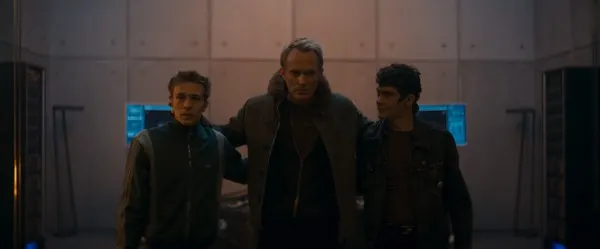
Terry Matalas built VisionQuest around one of storytelling's oldest tensions: the weight a father carries when confronted by what he has created and what he has lost. That the Disney+ series also became a vehicle for honoring the late Patrick Stewart — the actor who gave Matalas his greatest professional chapter as showrunner of Star Trek: Picard — gives its finale an emotional resonance that extends well beyond the Marvel Cinematic Universe.
A Show Defined by Fathers and Sons
When Kevin Feige tapped Matalas to take over the final installment of the WandaVision trilogy from creator Jac Schaeffer, the mandate was relatively straightforward: center the story on Paul Bettany's White Vision and his reincarnated son Tommy Maximoff. What Matalas did with that instruction, according to The Hollywood Reporter, was reach back into Marvel film history for the right dramatic foil. His mind went immediately to the haunting final exchange between Vision and Ultron at the close of Avengers: Age of Ultron — James Spader's performance in that scene nagging at him as a thread worth pulling. The result is a psychological chamber piece in which Vision, stripped of Wanda and adrift in fractured memory, must reckon with Ultron as a dark mirror of paternal dysfunction while simultaneously learning to accept Thomas Shepherd, an orphaned teenager who carries the soul of the son he never truly raised.
The architecture of the eight-episode series is essentially Greek in its symmetry: a creator tormented by his creation, a son searching for a father who barely knows himself. Matalas, whose writers' room was largely populated by colleagues from his Picard years, brings a similarly methodical hand to Marvel storytelling that he applied to Starfleet.
A Finale That Earns Its Runtime
The concluding episode, titled "Forever," deploys a structurally audacious device — trapping Vision and Ultron inside a WandaVision-style sitcom simulation — to force an A.I. built on contempt to feel genuine grief. It is the kind of move that only works when a show has laid sufficient emotional groundwork, and Matalas, who both wrote and directed the final two episodes, appears to have done exactly that. The resolution ties back to the trilogy's originating wound: Wanda's catastrophic loss. A post-credits sequence, withheld from press screeners, reveals Robert Downey Jr.'s Doctor Doom resurrecting Elizabeth Olsen's Wanda, who had apparently perished beneath rubble at the end of Doctor Strange in the Multiverse of Madness. The Maximoff family, it seems, is not finished.
Honoring Patrick Stewart
Matalas spoke to the outlet just hours before the finale dropped, and a portion of that conversation turned, inevitably, to Patrick Stewart, who died on October 28 at the age of 86. For Matalas, Stewart was not simply a collaborator but a standard-bearer — an actor whose fusion of Shakespearean discipline with science-fiction grandeur produced one of television's most indelible performances across the Picard run.
The image Matalas chose to hold onto is quietly perfect in its specificity: Stewart at the poker table in Picard's finale, surrounded by his crew, laughing. It is a farewell built from warmth rather than gravity, which feels entirely appropriate for a man whose craft and character defined so much of what prestige genre storytelling can aspire to. The tributes that have poured in from across the industry — including a deeply personal remembrance from Ian McKellen — speak to a career that was as much about human connection as it was about technical mastery.
Continuity and Closure
Matalas has spoken publicly about wanting all endings to circle back to their beginnings, and VisionQuest honors that instinct both within its own narrative and within the broader trilogy Schaeffer set in motion. Schaeffer, credited as executive producer but deliberately absent from the creative process, gave Matalas the room to build something new while still standing on the foundation of WandaVision. That balance — reverence without constraint — is ultimately what the best franchise storytelling requires, and what, in a different register, defined Patrick Stewart's relationship to every role he ever inhabited.
 ProfilePatrick StewartActor
Related
Randy Quaid Slams Anne Hathaway Casting in Days of Thunder Sequel
Randy Quaid, who appeared in the original 1990 film, took to X to demand Nicole Kidman's return and dismiss the Hathaway announcement.

Eva Mendes' 'de Gosling' Tattoo Is the Only One She's Ever Wanted
Eva Mendes is showing off her wrist tattoo again — a small but meaningful piece of ink that carries a deep cultural significance.
Steven Spielberg's 'War of the Worlds' Returns to Streaming Amid Debate
Steven Spielberg's 'War of the Worlds' is hitting HBO Max next month, reigniting discussions on its mixed reception.