Cate Blanchett Accepts Praemium Imperiale, Champions Doubt as Creative Force

The two-time Oscar winner joined a legendary roster of arts laureates in Tokyo, offering a thoughtful meditation on uncertainty, language, and artistic courage.
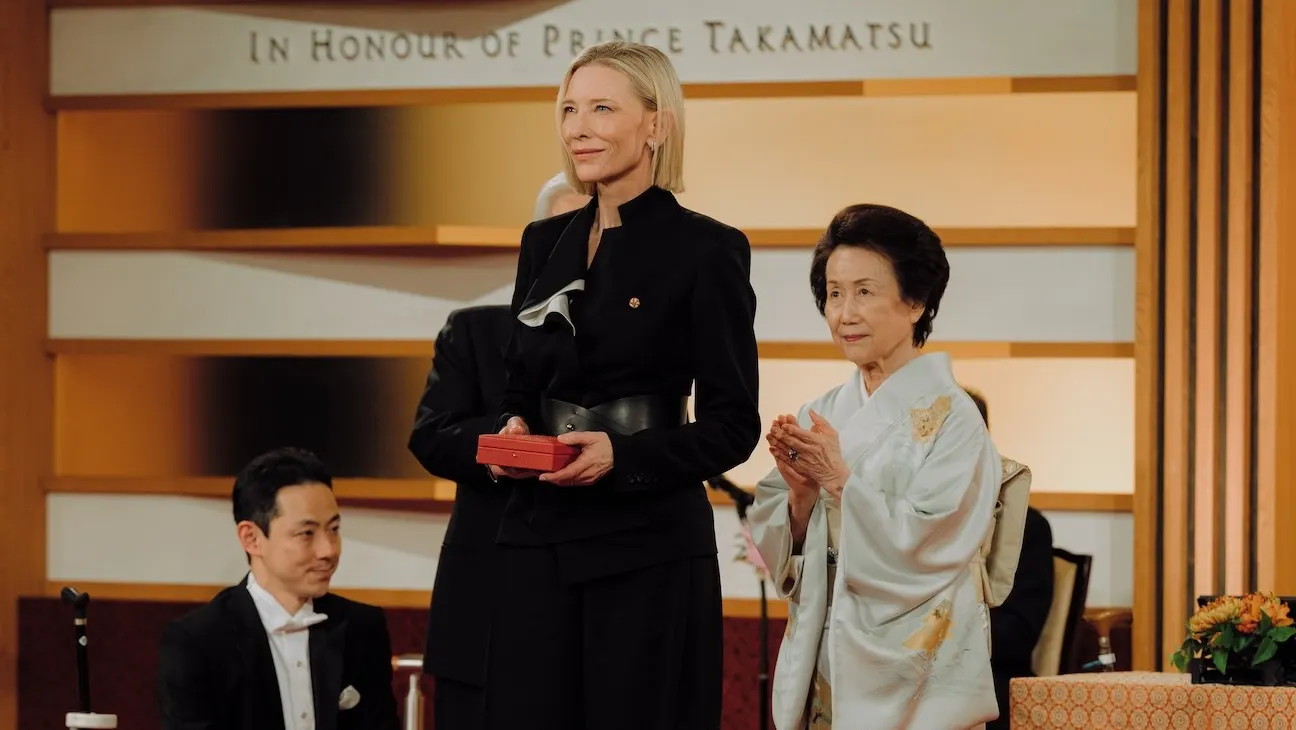
Few living performers occupy the cultural territory that Cate Blanchett does — an artist whose career reads less like a filmography and more like a sustained argument for the value of serious creative work. That standing was formally acknowledged on Wednesday when the two-time Academy Award winner received Japan's Praemium Imperiale, one of the most distinguished honors in the international arts calendar, at a black-tie ceremony held at the Meiji Kinenkan in Tokyo's Moto-Akasaka district.
An Honor Among Legends
Presented by the Japan Art Association and often characterised as the Nobel Prize of the arts, the Praemium Imperiale recognises lifetime achievement across five disciplines: painting, sculpture, architecture, music, and theater and film. Blanchett now stands alongside a theater and film lineage that includes Federico Fellini, Akira Kurosawa, Jean-Luc Godard, Martin Scorsese, Judi Dench, and Catherine Deneuve — a roll call that doubles as a short syllabus in the history of global cinema. Ang Lee received the prize in 2024, making Blanchett the latest Hollywood-associated figure to be so honoured. Japan's Princess Hitachi presided over the presentation; each laureate also receives a testimonial letter and an honorarium of 15 million yen, equivalent to just under $100,000. This year's fellow recipients were American artist Jenny Holzer, British sculptor Andy Goldsworthy, American architect Daniel Libeskind, and Swedish conductor Herbert Blomstedt, according to The Hollywood Reporter.
For those who have followed Blanchett's film work closely, the recognition feels less like a surprise than an inevitability — a formal institution catching up to what audiences have observed across decades of uncommonly intelligent screen performance.
Doubt as Discipline
At a press conference ahead of the ceremony, Blanchett used the occasion not for self-congratulation but for something closer to a philosophical statement about the conditions under which meaningful art is made. Opening her acceptance speech with a reference to surrealist artist Leonora Carrington, she described acting as a profession that, at its weakest, collapses into literal illustration — and at its strongest, exceeds the reach of language altogether.
Her working method, she explained, centres on the charged space between what a character articulates and what remains stubbornly beyond words. It is in that gap — in what is said, what is withheld, what is wished for and what is regretted — that she locates her creative entry point. The posture required to inhabit that space is not confidence in the conventional sense, but something she distinguished sharply from it: doubt. "In an uncertain world riddled with unthinking certainty I believe doubt is vital to the creative process," she said, describing it as the faculty that enables genuine listening, seeing, and sensing.
The observation carries particular weight at a moment when cultural and technological pressures push relentlessly toward the declarative and the certain — a theme that connects naturally to Blanchett's ongoing advocacy around artificial intelligence and consent.
Clinton, AI, and the Stakes of Culture
Former U.S. Secretary of State Hillary Clinton, present at the press conference in her role as the prize's U.S. international adviser, offered a complementary argument — that the Praemium Imperiale functions as a global affirmation that artists and cultural institutions are not peripheral to healthy societies but foundational to them. Clinton specifically invoked the disruptions posed by artificial intelligence, arguing that the human capacities of imagination and connection need active defence rather than passive assumption.
Tokyo and What Comes Next
Blanchett's time in Japan extends well beyond the ceremony. Her engagements at the 39th Tokyo International Film Festival, running through November 4, include a Q&A alongside directors Mohammad Rasoulof and Shahrbanoo Sadat following Japanese premieres of five short films backed by the Displacement Film Fund — the initiative Blanchett co-founded to support filmmakers forced from their home countries. Later the same day, she is scheduled to join David and Nathan Zellner for a conversation surrounding their alien comedy Alpha Gang, in which she stars.
She closed her Tokyo remarks with the kind of unaffected grace that distinguishes the genuinely accomplished from the merely celebrated: "It's an Olympus of sorts that I never conceived of even touching. It's a beautiful, soul-soaring surprise, and a deep honor indeed."
 ProfileCate BlanchettActress and producer
Related
Randy Quaid Slams Anne Hathaway Casting in Days of Thunder Sequel
Randy Quaid, who appeared in the original 1990 film, took to X to demand Nicole Kidman's return and dismiss the Hathaway announcement.

Eva Mendes' 'de Gosling' Tattoo Is the Only One She's Ever Wanted
Eva Mendes is showing off her wrist tattoo again — a small but meaningful piece of ink that carries a deep cultural significance.
Steven Spielberg's 'War of the Worlds' Returns to Streaming Amid Debate
Steven Spielberg's 'War of the Worlds' is hitting HBO Max next month, reigniting discussions on its mixed reception.