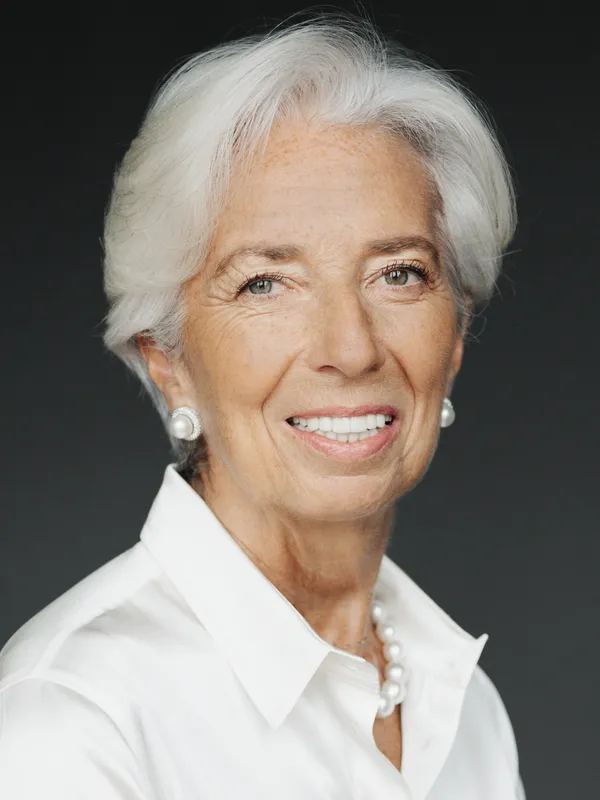
Christine Lagarde
Central banker & lawyer
Christine Lagarde is a French lawyer and policymaker who became President of the European Central Bank (ECB) in November 2019. Before leading the ECB, she served as Managing Director of the International Monetary Fund (IMF) from 2011 to 2019 and, earlier, held senior posts in the French government, including Minister of the Economy, Finance and Industry. She is widely recognized as one of the most influential figures in global economic policy.
Early life
Christine Madeleine Odette Lallouette was born on January 1, 1956, in Paris and grew up in Le Havre, in northwestern France. As a teenager she was a member of the French national synchronized swimming team. She studied at Paris Nanterre University, where she earned degrees in law, and later completed a master's degree at the Institut d'etudes politiques d'Aix-en-Provence. Rather than pursue the traditional French civil-service track, she trained as a lawyer and joined the international law firm Baker & McKenzie, where she specialized in antitrust and labor law.
Career
Lagarde rose through Baker & McKenzie to become chairman of its global executive committee in 1999, the first woman to hold the position, leading the firm until 2005. That year she entered French public life, serving briefly as Minister of Foreign Trade before becoming Minister of Agriculture and, in 2007, Minister of the Economy, Finance and Industry under President Nicolas Sarkozy. She was the first woman to hold the finance portfolio in a major industrialized economy and steered French policy through the global financial crisis of 2008.
In 2011 she was appointed Managing Director of the IMF, becoming the first woman to lead the institution. During her tenure she oversaw the Fund's response to the European sovereign-debt crisis and programs in countries such as Greece, and she was reappointed to a second term in 2016. She frequently spoke about the importance of financial stability, inclusive growth, and greater participation of women in the economy.
Recent work
Lagarde took over as President of the European Central Bank in November 2019, succeeding Mario Draghi. As the first woman to lead the ECB, she guided the euro area's monetary policy through the economic shock of the COVID-19 pandemic, supporting large-scale asset-purchase programs to stabilize the economy. From 2021 onward she confronted a surge in inflation across the euro zone, overseeing a series of interest-rate increases intended to bring price growth back toward the bank's target, followed later by a gradual shift in policy as inflation eased. She has also championed the ECB's work on climate-related financial risk and the exploration of a potential digital euro. Known for a measured, communicative public style, Lagarde remains a central voice in debates over the future of the European economy.
Videos



FAQ
Christine Lagarde — Frequently asked questions
How old is Christine Lagarde?+
Christine Lagarde was born on January 1, 1956, which makes 70 years old.
Where is Christine Lagarde from?+
Christine Lagarde is from France.
What is Christine Lagarde known for?+
Christine Lagarde is best known as Lawyer, Politician, Economist. Notable work includes President of the European Central Bank, former Managing Director of the IMF, former French Finance Minister.
Is Christine Lagarde on social media?+
Yes — Christine Lagarde is on X (Twitter). You can find the official links on this page.