Trump Calls Strait of Hormuz 'American Territory' as Iran Talks Stall

President Trump has repeatedly asserted U.S. dominion over the strategic waterway, drawing sharp pushback from Tehran and raising fresh diplomatic concerns.
President Donald Trump escalated his rhetoric over the Strait of Hormuz this week, publicly declaring the internationally recognized waterway to be "American territory" at a campaign-style event in South Carolina — a claim Iran has flatly rejected as peace negotiations continue to founder. The remarks are the latest in a pattern of assertions that have drawn scrutiny both abroad and from within his own party, according to The Guardian World.
Trump's Repeated Claims Over the Strait
At the South Carolina event, Trump told the audience, "I view the strait of Hormuz as an American territory right now. It's an American territory." The statement echoed language he had used the previous week during a speech in New York, where he signaled he intended to formally designate the strait as U.S. territory "pretty soon." He had also posted on social media claiming the United States held "total control" over the waterway, adding that he believed the U.S. would "keep it."
The Strait of Hormuz is one of the most strategically significant chokepoints in global trade, connecting the Persian Gulf to the Gulf of Oman and serving as a primary transit route for a substantial share of the world's oil supply. The strait is bordered by Iran to the north and Oman to the south — neither of which has recognized any American claim over it.
Iran Holds Its Ground
Tehran has shown no willingness to accept Trump's framing. Kazem Gharibabadi, Iran's deputy foreign minister, stated last week that Iran would not be intimidated by the president's statements and that the strait would only be reopened under Iranian authority. Iran has kept the waterway closed as peace talks between Washington and Tehran remain at an impasse, with no breakthrough in sight.
The standoff is compounding economic pressures at home. Gas prices have climbed to record levels amid the ongoing conflict, adding urgency to efforts — so far unsuccessful — to reach a settlement. The administration's struggle to bring the war to a close has prompted broader questions about the effectiveness of its diplomatic strategy, at a moment when Trump is simultaneously navigating trade disputes with key allies. His recent threats of sweeping tariffs on European digital services have further strained relationships Washington may need in applying pressure on Iran.
Domestic Friction Over Trade Policy
The Hormuz controversy is not the only front where Trump is facing dissent this week. Senator Tim Sheehy, a Montana Republican and cattle rancher, publicly broke with the president over a separate decision to temporarily allow 300,000 metric tonnes of imported ground beef to enter the country duty-free for 90 days. Trump announced the plan on Truth Social, framing it as a measure to ease consumer prices that have risen partly due to a Mexican screwworm infestation affecting domestic livestock.
Sheehy, however, argued the move would undercut American ranchers who are already struggling against consolidation in the meatpacking industry. "I've advised President Trump against this course of action for a year because American ranchers have been struggling against the packer monopoly for decades," Sheehy wrote, adding that the policy would make it harder for domestic producers to rebuild herd numbers and ultimately reduce prices over time. The senator credited Trump's intentions but said the practical consequences would fall hardest on the rural, conservative communities that have been among the president's most loyal supporters.
A Presidency Under Pressure
The dual controversies — one geopolitical, one economic — illustrate the competing pressures bearing down on the Trump administration at this stage of his second term. His financial standing has been a subject of public interest as well; Trump recently reported $2.2 billion in revenue during the initial year of his second term, figures that continue to fuel debate about conflicts of interest.
Meanwhile, the administration's posture on the Strait of Hormuz will be closely watched by U.S. allies, particularly NATO partners already navigating uncertainty in the transatlantic relationship following Trump's recent meeting with NATO Secretary General Mark Rutte. Whether Trump's territorial claims over the strait represent a formal policy shift or negotiating leverage remains unclear — but Tehran, at least, appears to be treating them as neither.
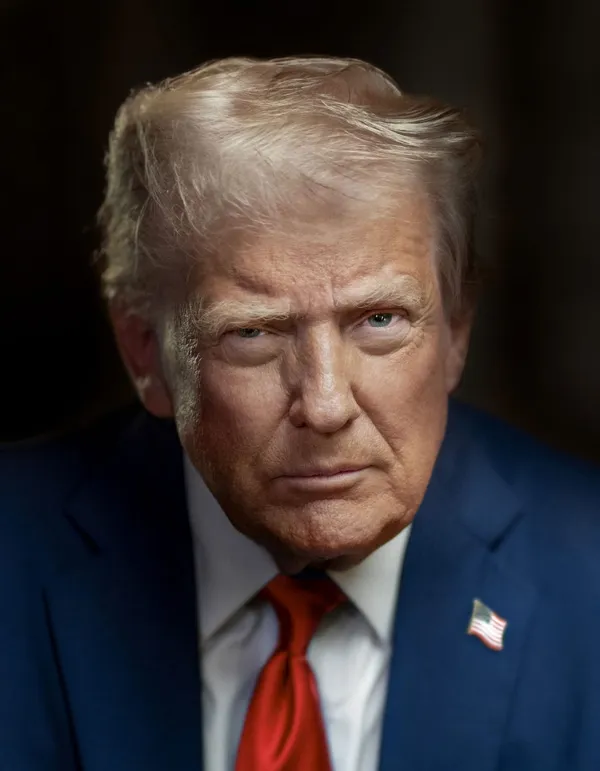 ProfileDonald Trump45th and 47th President of the United States
Related
California Senate Passes Post-Production Tax Bill; Newsom Must Act
SB 2319 cleared the California State Senate 33-5, creating a dedicated post-production tax incentive as the L.A. film industry continues to shrink.

Netanyahu Condemns West Bank Attack on NBC News Team as Settler Violence Escalates
Masked settlers assaulted an NBC News crew and a Palestinian woman in Jalud, injuring four journalists and drawing condemnation from Israel's prime minister.
Park Service Backs Trump Arch Despite Threat to DC Landmark Sightlines
A federal report endorses the proposed 250-foot gilded arch while acknowledging it will disrupt the visual integrity of dozens of historic Washington sites.