Cate Blanchett Urges London Audience to Stay Present, Not Record

After the curtain call of Electra/Persona at the National Theatre, Cate Blanchett made a passionate plea for undivided audience attention.
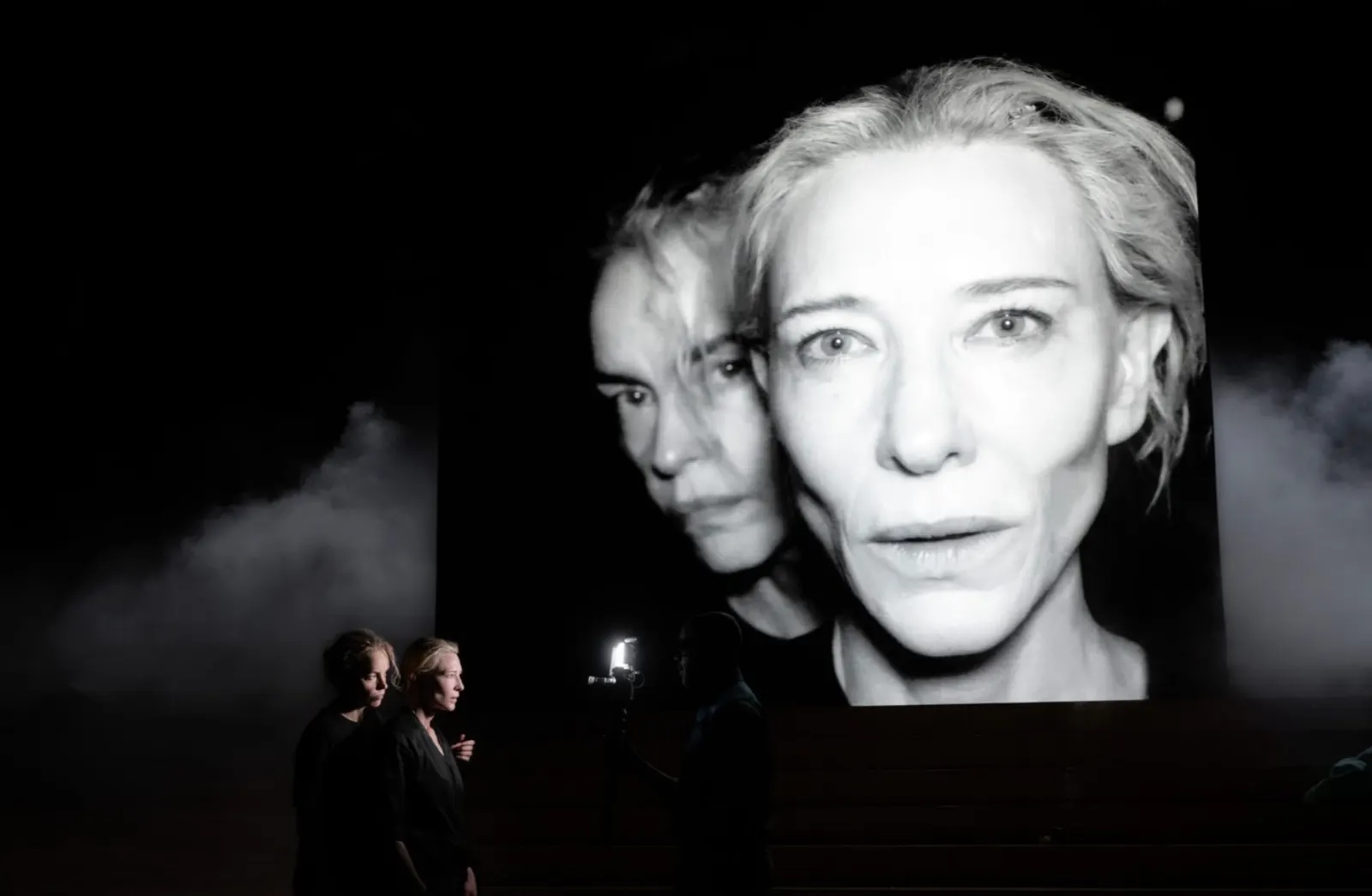
There is a long-standing tension between the ephemerality of live theatre and the modern compulsion to document every remarkable moment — and few performers are better positioned to articulate that tension than Cate Blanchett. Following the curtain call of her new stage production at London's National Theatre, the two-time Oscar winner stepped forward to address the audience directly, asking them to put their phones away and be fully present in the shared space of the theatre.
A Plea From the Stage
According to Deadline, Blanchett delivered her remarks from the Lyttelton Theatre stage after the conclusion of Electra/Persona, a bold new work written and directed by Benedict Andrews. The piece fuses two canonical texts — Sophocles' ancient Greek tragedy Electra and Ingmar Bergman's landmark 1966 film Persona — into a single theatrical experience. In her post-curtain address, Blanchett described the stage as a place "where we can simply be together and be present," framing live performance as a fundamentally communal and irreducible act that cellphone recording fundamentally undermines.
Her words carry particular weight given the intellectual ambition of the production itself. Bergman's Persona is, among other things, a film deeply concerned with identity, perception, and the instability of the image — making the irony of audience members trying to capture it on their phones almost too pointed to ignore. Sophocles, for his part, wrote for audiences gathered in open-air amphitheatres where collective witness was woven into the civic fabric of Athenian life. Andrews' synthesis of these two sources places Blanchett at an intersection of theatrical traditions that have always demanded full attention.
The Broader Conversation About Phones in Performance Spaces
Blanchett's appeal joins a growing chorus of performers and directors who have grown frustrated with the creeping intrusion of smartphones into live events. From Broadway to the West End, the issue has become something of a culture war in miniature — pitting audience members' desire to preserve memories against performers' need for undivided engagement and the basic courtesy owed to fellow theatregoers. Some venues have turned to technology, using signal-blocking pouches, while others have relied on pre-show announcements that are routinely ignored.
What makes Blanchett's approach distinctive is the framing. Rather than issuing a prohibition, she offered a philosophy — articulating why the theatre, as opposed to cinema or a streamed performance, exists in a category of its own. It is a sentiment consistent with her wider advocacy for the arts as a space for genuine human connection. Blanchett has been vocal on related issues of culture and creative freedom; she recently championed digital consent rights for artists in Brussels, underscoring that her concerns about technology and artistic integrity extend well beyond a single curtain speech.
Andrews, Blanchett, and the Weight of the Production
The collaboration between Blanchett and Andrews is itself a significant theatrical event. Andrews, an Australian director who has worked extensively in Europe, brings a visually rigorous sensibility to the stage, one that aligns naturally with the cinematic density of Bergman's source material. Casting Blanchett — an actress who has consistently gravitated toward roles that interrogate performance, identity, and power — in this dual-source work feels less like a production decision and more like an inevitability.
Blanchett's stage work has always existed in productive dialogue with her screen career. Audiences who followed her earlier this year when she took center stage at the Tokyo International Film Festival will recognize an artist who moves fluidly between mediums while remaining deeply invested in the conditions under which art is received, not merely made.
Presence as a Form of Respect
There is something genuinely radical, in today's attention economy, about an actor asking an audience to simply watch. Blanchett's curtain call appeal was not a diva moment or a legal reminder about copyright — it was a considered argument for the value of undivided presence, delivered by someone who has given decades of her professional life to creating experiences worth being present for. For audiences lucky enough to have witnessed Electra/Persona in person, the request was perhaps the most fitting final note the evening could have struck.
Related on Ni4o: Cate Blanchett Launches Free AI Consent Tool in Brussels
 ProfileCate BlanchettActress and producer
Related
Randy Quaid Slams Anne Hathaway Casting in Days of Thunder Sequel
Randy Quaid, who appeared in the original 1990 film, took to X to demand Nicole Kidman's return and dismiss the Hathaway announcement.

Eva Mendes' 'de Gosling' Tattoo Is the Only One She's Ever Wanted
Eva Mendes is showing off her wrist tattoo again — a small but meaningful piece of ink that carries a deep cultural significance.
Steven Spielberg's 'War of the Worlds' Returns to Streaming Amid Debate
Steven Spielberg's 'War of the Worlds' is hitting HBO Max next month, reigniting discussions on its mixed reception.