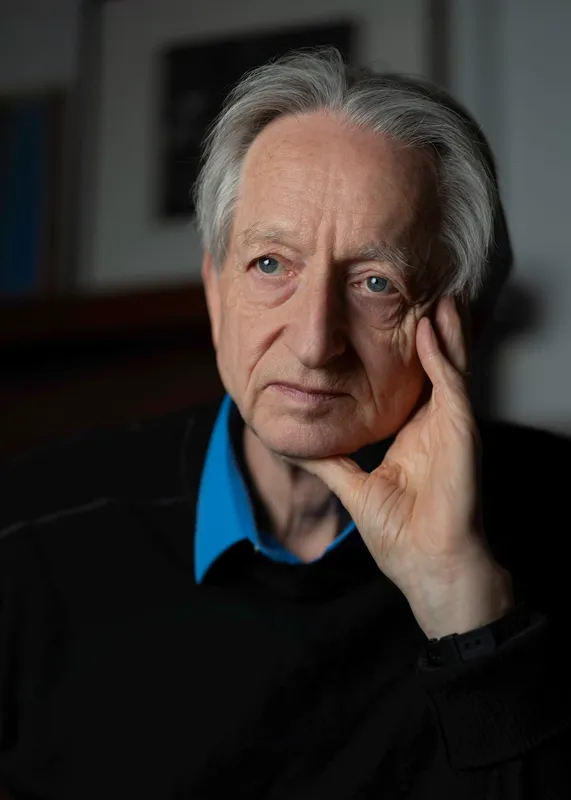
Geoffrey Hinton
Pioneer of Deep Learning
Geoffrey Hinton is a British-Canadian computer scientist and cognitive psychologist often described as one of the godfathers of modern artificial intelligence. His decades of research on neural networks laid much of the theoretical and practical foundation for the deep learning systems that now power image recognition, language models and many other technologies.
Early Life and Education
Born in London in 1947 into a family with a distinguished scientific lineage, Hinton studied experimental psychology at the University of Cambridge before earning a doctorate in artificial intelligence at the University of Edinburgh. His early fascination with how the human brain represents and processes information shaped a lifelong pursuit: building computational models inspired by biological neurons. He pursued this path during periods when neural network research was deeply unfashionable, persisting through what some called an AI winter.
Foundational Research
Hinton's most influential contributions centre on artificial neural networks. In the 1980s he was among the researchers who popularised the backpropagation algorithm, a method for training multi-layer networks by efficiently adjusting their internal connections. This technique became the workhorse of modern machine learning. He also contributed to ideas such as Boltzmann machines and distributed representations, helping establish how networks could learn meaningful internal features from data.
A pivotal moment came in the early 2010s, when Hinton and two of his students demonstrated that deep neural networks, trained on powerful graphics processors, could dramatically outperform existing methods in image classification. Their success in a major computer vision competition is widely seen as a turning point that ignited the deep learning revolution and reshaped the entire field of artificial intelligence.
Academia and Industry
Hinton spent much of his career as a professor at the University of Toronto, where he mentored many researchers who went on to lead AI work around the world. He also held a long association with Google after the company acquired a startup he co-founded, allowing him to combine academic research with industrial-scale applications. His work helped neural networks move from a niche pursuit into the core of products used by billions of people.
In recognition of his contributions, Hinton received the A.M. Turing Award, often called the Nobel Prize of computing, sharing it with two fellow pioneers. In 2024 he was awarded the Nobel Prize in Physics for foundational discoveries that enable machine learning with artificial neural networks, a striking acknowledgement of the field's significance.
Warnings About AI
In recent years Hinton has become a prominent voice cautioning about the risks of the technology he helped create. He stepped back from his role at Google so that he could speak more freely about his concerns, warning that increasingly capable AI systems could pose serious societal dangers, from the spread of misinformation to longer-term existential risks. His warnings have carried particular weight given his central role in the field.
Legacy
Geoffrey Hinton's influence on artificial intelligence is difficult to overstate. By championing neural networks through years of skepticism and helping prove their power, he reshaped computing and opened the door to the current era of AI. His later turn toward caution adds a thoughtful, sometimes sobering dimension to a remarkable scientific legacy.
Videos

FAQ
Geoffrey Hinton — Frequently asked questions
How old is Geoffrey Hinton?+
Geoffrey Hinton was born on December 6, 1947, which makes 78 years old.
Where is Geoffrey Hinton from?+
Geoffrey Hinton is a citizen of United Kingdom and Canada.
What is Geoffrey Hinton known for?+
Geoffrey Hinton is best known as Computer scientist, Psychologist, University teacher. Notable work includes Backpropagation research, deep neural networks, Turing Award, Nobel Prize in Physics 2024.
Is Geoffrey Hinton on social media?+
Yes — Geoffrey Hinton is on X (Twitter). You can find the official links on this page.