Ian Fleming's 1950s Bond Sketch Looks Remarkably Like Robert Pattinson

A portrait of 007 commissioned by Bond creator Ian Fleming decades before the films existed bears a striking resemblance to the franchise's newest star.
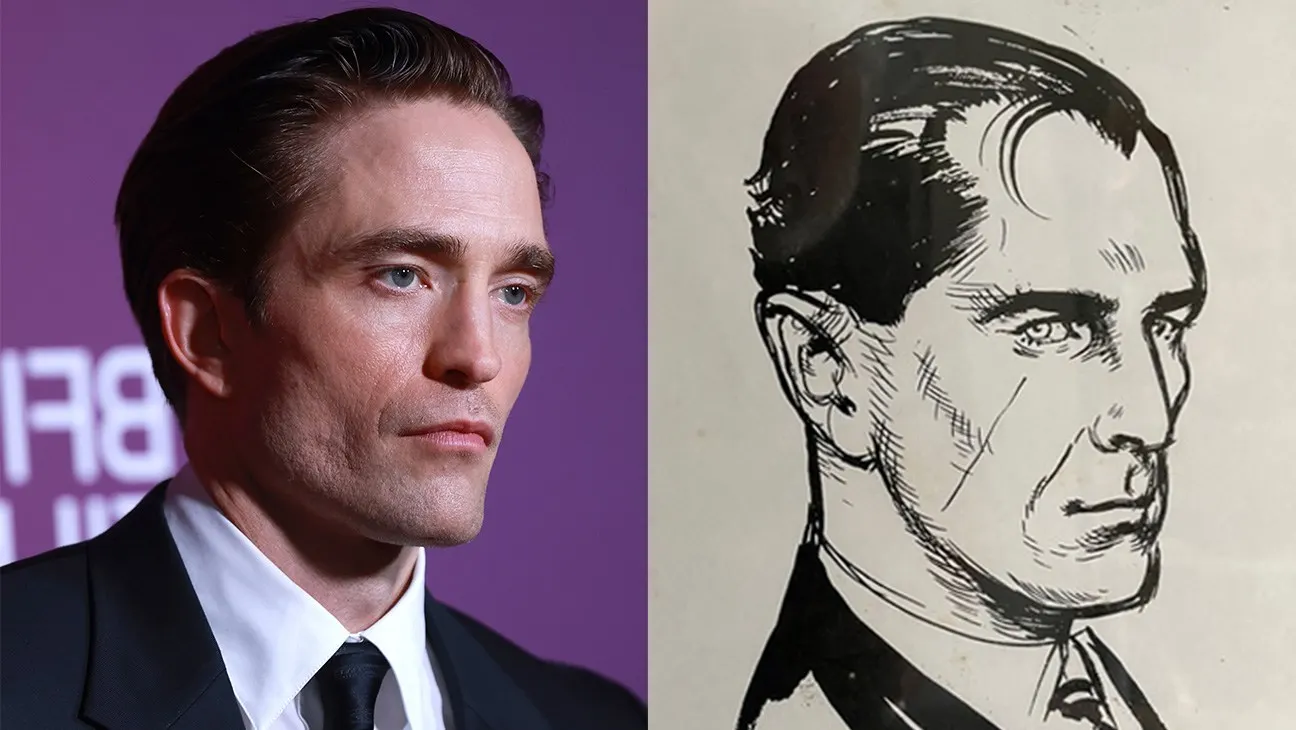
Before a single frame of a Bond film had ever been shot, Ian Fleming knew exactly what his spy looked like — and, as it turns out, he was about seven decades early in his casting instincts. A recently surfaced piece of franchise history suggests that Robert Pattinson may be the most physically faithful 007 the series has ever produced, not by accident, but by an almost eerie alignment with the author's original vision.
Fleming's Blueprint for Bond
According to The Hollywood Reporter, when a British newspaper acquired the rights to adapt Fleming's novels as a serialized comic strip in the 1950s, the author took the visual side of the project seriously enough to commission a portrait of Bond from an unknown artist. Fleming's instructions were exacting — he even specified in one note a desire to avoid giving the character an "American-shaped head and a duck's haircut" — and the resulting sketch reflected that precision. The face that emerged from those sessions featured a long, angular structure, prominent brow bones, a narrow nose, sharply defined cheekbones, thin lips, and a squared-off chin. It is, by any honest reckoning, the face of Robert Pattinson.
Beyond facial geometry, Fleming had also documented Bond's physical profile within the fiction itself, most notably through the SMERSH dossier referenced in the novels. That description puts the agent at approximately six feet tall, around 168 pounds, with black hair and blue eyes — a combination that Pattinson satisfies in full. None of his predecessors managed a clean sweep. Sean Connery and George Lazenby had the dark hair but brown eyes. Roger Moore brought the blue eyes but lighter hair. Pierce Brosnan came closest among the classic-era actors, checking both boxes for coloring, though Fleming's more detailed structural specifications remained unmet.
The Illustrator Who Accidentally Cast Connery
What makes the historical footnote particularly rich is what happened next. The newspaper's chosen illustrator, John McLusky, apparently set Fleming's carefully delivered instructions aside and drew Bond according to his own dramatic sensibilities. McLusky's version was broader and more emphatically rugged — a wider jaw, a cleft chin, narrower eyes, and a general quality of physical dominance that read less like Fleming's lean, almost aristocratic template and more like a certain Scottish actor who would be cast in the role a few years later. Sean Connery's Bond, in other words, was arguably McLusky's Bond before it was Fleming's.
The irony is complete: the author's precise visual conception of his own character was essentially overruled by both the illustrator and by six decades of film casting, only to find its closest real-world match in an actor best known for playing a vampire in his early career. For more on how that earlier franchise informs Pattinson's current trajectory, it's worth reading about how Pattinson draws Twilight parallels for his villain role in The Odyssey, which suggests the actor himself sees connective tissue between his various genre-defining roles.
Craft Over Controversy
The conversation around Pattinson's Bond casting has not been entirely smooth — detractors have questioned whether he projects the requisite authority for the role — but the physiological evidence from Fleming's own archive offers a different frame of reference. The question of what Bond should look like, at least by the character's creator's standard, appears to have a clear answer. Whether Pattinson can embody the psychological and performative dimensions of the role is a separate matter, and one that his increasingly bold choices as an actor — across films from Cannes to Tom Holland finding relief with Robert Pattinson's casting in The Odyssey — suggest he is well-equipped to explore.
For now, the portrait from the 1950s stands as a quietly compelling piece of evidence that sometimes a creator's vision, however long delayed, eventually finds its way to the screen.
Related on Ni4o: Robert Pattinson's Best Twilight Film Exits HBO Max This July
 ProfileRobert PattinsonActor
Related
Randy Quaid Slams Anne Hathaway Casting in Days of Thunder Sequel
Randy Quaid, who appeared in the original 1990 film, took to X to demand Nicole Kidman's return and dismiss the Hathaway announcement.
Eva Mendes' 'de Gosling' Tattoo Is the Only One She's Ever Wanted
Eva Mendes is showing off her wrist tattoo again — a small but meaningful piece of ink that carries a deep cultural significance.
Steven Spielberg's 'War of the Worlds' Returns to Streaming Amid Debate
Steven Spielberg's 'War of the Worlds' is hitting HBO Max next month, reigniting discussions on its mixed reception.